

Updated: Nov-26, 2011
My Attitude Gauge has been updated as follows:
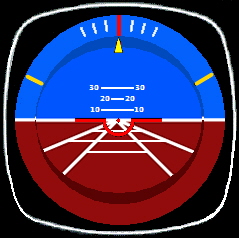
A copy of this update has been sent to those friends who asked for my FIP Gauge set below. If not, please email me.
Updated: Nov-26, 2011
My Attitude Gauge has been updated as follows:
A copy of this update has been sent to those friends who asked for my FIP Gauge set below. If not, please email me.
Although the result from the First Run was good, the ultimate goal is still to push the Image and Autogen Complexity of my FSX system to the maximum while having all flights running as smooth as possible.
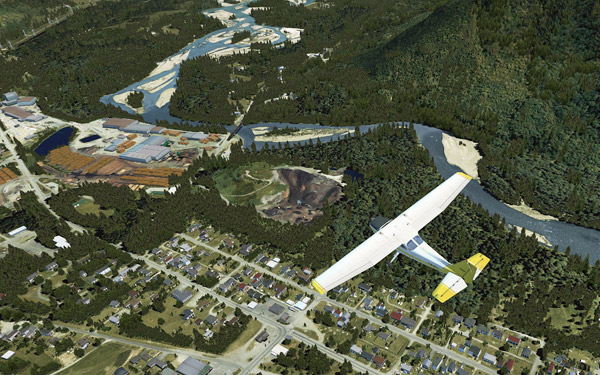
As expected, when settings of Scenery Complexity and Autogen Density were slided to Extremely Dense, stutters became obvious even though overall framerates remained relatively stable around the preset level of 39.
For this tuning, most of the test flights were taken place in Darrington Mun 1S2. Continue reading
RejectThreshold is a command that instructs the CPU to bypass the bufferpool when a specified amount of graphics data is reached. Before that threshold, all data are kept sending to the bufferpool.
This function can be used in association with the PoolSize command to improve system stability.
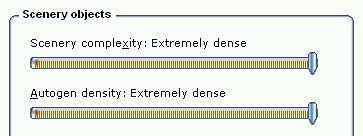
The default quantities of trees and buildings auto-generated in FSX are 4,500 and 3,000 respectively.
When one sets the IMAGE_COMPLEXITY and AUTOGEN_DENSITY to the maximum, reducing either or both of these two quantities for trees and buildings could bring a significant performance improvement while maintaining a good level of image complexity and density.
 Continue reading
Autogen has a default texture buffer of 4 millions. Properly increasing or decreasing this buffer can effectively reduce stutters, especially while the aircraft is in turning.
This function is not by default present in fsx.CFG. To alter the value, one can add the following lines in fsx.CFG; and commonly used values range from 1 million to 15 million (or even higher) in 1 million increment.
[BufferPools]
PoolSize=15000000
My First Run took place in Concrete Mun 3W5 with framerate locks at 39, after the initial tunings from Part 1 and Part 2.
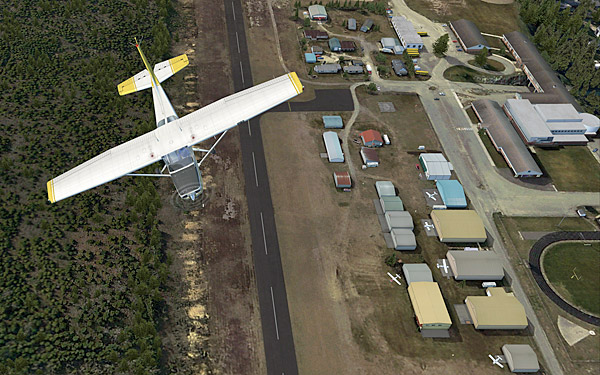
Before the actual flight, a few more adjustments were made directly in the fsx.CFG as follows: Continue reading
 FS Times