
I bet many friends like me have heard about the various flightsim gears from Redbird Flight Simulations, and very likely might have read reviews and comments about them on the Internet. But I don’t think many of us really had a chance to try them on, because the company doesn’t sell their gears thru third-party vendors — at least I haven’t noticed anyone yet.
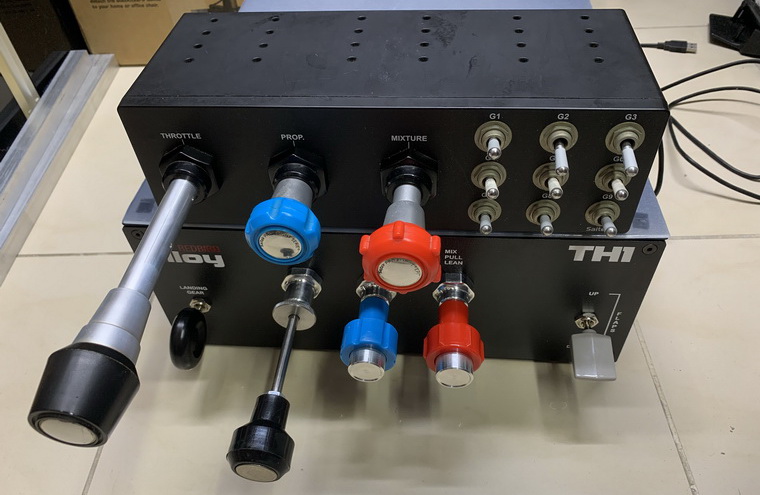 Recently, I got the Alloy TH1 throttle quadrant from the company to replace my Saitek Cessna TPM which has been in service for over a decade in my work system.
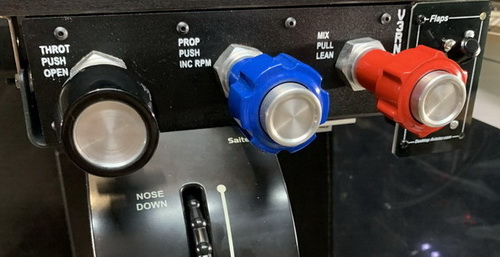 In my flightsim-only setup, I have the VirtualFly V3RNIO+.
Actually, I was thinking of getting another V3RNIO+ to replace the Saitek TPM at the time the company was offering a 15% discount promotion.
However, the discounted price was around $900, which is still a lot of money, not to mention an extra $100 for the shipping to be added.
While I was hesitating if I should go for another V3RNIO+, I came across the Redbird Alloy TH1 again.
Just like the VirtualFly V3RNIO+, the Redbird Alloy TH1 is also a vernier-style throttle quadrant that comes with a Throttle Friction Lock and Propeller & Mixture Fine-adjustment Control mechanisms as found on the real aircraft. And it earns some good comments from its users, too.
In addition, its $569 price tag, comparatively, sounds more reasonable and affordable.
Therefore, after some serious considerations and especially due to the $350 in price difference (or $480 with no discount), I decided to give the Redbird Alloy TH1 a go.
For more than a month now, I’ve been using the Alloy TH1 extensively.
Is my bold investment on the Alloy TH1 justified? How does it perform compared to the VirtualFly V3RNIO+? Here’s my review:
–
BODY CONSTRUCTION
The Redbird Alloy TH1 is largely made of Alloy as its name suggests, and no doubt a robust design. Its dimensions and weight are as follows:
- Alloy TH1: 13.25(W) x 17.00(D) x 5.25(H) inches (or 432.0 x 336.5 x 133.4 mm)
- : 9 pounds (4.08kg)
- V3RNIO+: 7.45(W) x 11.70(D) x 2.23(H) inches (189 x 297 x 56.5 mm)
- : 8.82 pounds (4kg)
The numbers may not convey any image of it.
Let’s put in this way, the Alloy TH1 is huge, in terms of a device just for the TPM and landing gear and flaps operations.
In comparision by volume, the VirtualFly V3RNIO+ is only about 1/6 of it.
Unfortunately, I wasn’t able to take some pictures showing the two units putting side-by-side or stacking together. The company’s product photo below, however, should somewhat tell the “XL” size of it.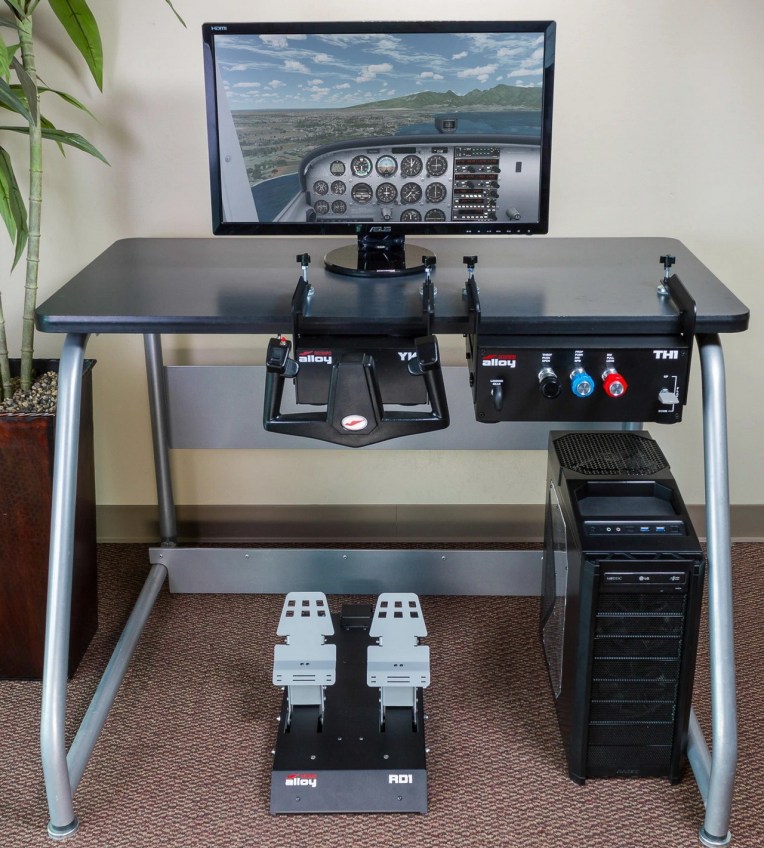 Regarding craftsmanship and materials used on the Alloy TH1, they are good and on par to what the unit is priced.
But I have to say that when the Alloy TH1 is compared to the VirtualFly V3RNIO+, the latter does better in many details. Understandable, the difference in price also reflects the difference in quality too.
–
Placement
Unlike the VirtualFly V3RNIO+, the Redbird Alloy TH1 doesn’t come with any mounting bracket.
Nevertheless, due to its large footprint and heavy weight, one can place it on top of most flat surface steadily, although it’s better with the help of some sticky tapes under it or some weights on top of it.
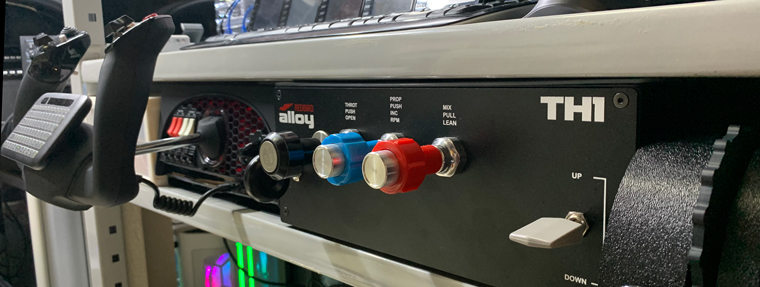
However, should one need to mount the unit under the table like the photo shown 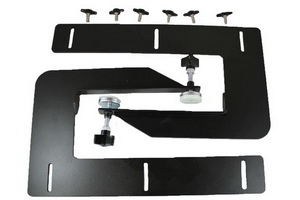 above, the company offers a pair of $79 Mounting Arms to do the job.
Regardless of price, the way how the arms mount the unit is a bit queer, frankly speaking. Also, it is an awfully waste of space. I would suggest any user who has the need to mount the unit under the table to find other mounting solutions.
I am sure there are better and cheaper ways to achieve the same result.
In my work setup, there is another plate surface under my table to which I can custom adjust the height between the two surfaces to fit the Alloy TH1 properly. So I don’t need any means to secure it.
–
Installation
The Alloy TH1 doesn’t need any driver and it can be instantly recognized as a plug-n-play gaming device via its USB 2.0 port in the back of it.
I actually connect it to a USB 3.0 port on my computer since its installation more than a month ago. No anomaly encountered so far.
–
Setting in MSFS
The configurations of the throttle, propeller and mixture axes on the Alloy TH1 in MSFS are straightforward. Same applies to the Landing Gear and Flaps Switches.
However, MSFS only recognizes it as a generic gaming device.
On the contrary, MSFS does recognize the name of the VirtualFly V3RNIO+ instantly, and displays a picture of it when it is connected.
–
Operations & Accuracy
In general, there isn’t much difference between the Redbird and VirtualFly throttle quadrants when simulating the throttle, propeller and mixture operations on the real aircraft.
Besides the pull-push actions, the throttle axis can be locked and released by the friction lock as needed. And the propeller and mixture levels can be fine-tuned by rotating the propeller and mixture knobs clockwise and anti-clockwise accordingly.
Regarding accuracy, both Redbird and VirtualFly units are responsive and accurate in MSFS, and in X-Plane, too. I don’t see any noticeable difference between the two devices, despite of what senors and technologies they are using.
–
SUMMARY 1: THINGS I like
- The operations of the throttle, propeller and mixture axes on the Alloy TH1 are responsive and accurate.
- The unit comes with an extra Landing Gear and Flaps Switches that the VirtualFly V3RNIO+ doesn’t have. They are handy features, too.
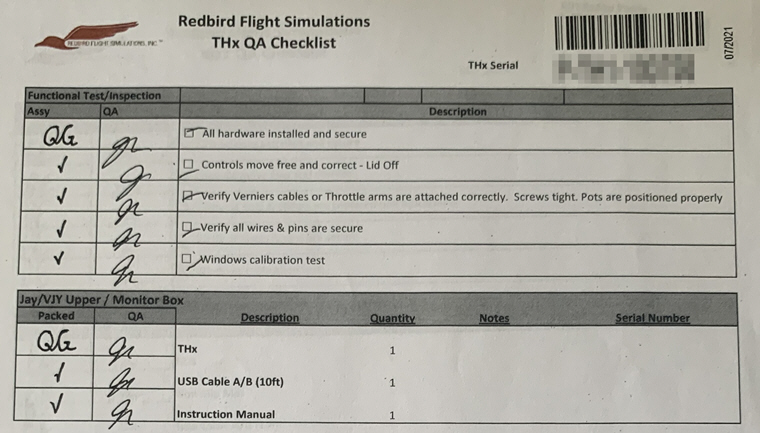
- There is even a QA Checklist signed off by the company before delivering the unit to me.
–
SUMMARY 2: THINGS I DISlike
- Although my work desk can accomodate the Alloy TH1 properly, the unit is still a bit over-sized to me, which may pose a barrier to many other flightsimmers who are interested in the device as well in my opinion.
- There were some parts of the edges on the plastic TPM knobs a little sharp. They were insignificant but my fingers could feel the sharpness on them. I needed to sand them out myself. Although these sharp edges wouldn’t hurt, more attentions paid to these details by the company are definitely required.
- Mounting Arms don’t come as standard accessories, though I don’t need them.
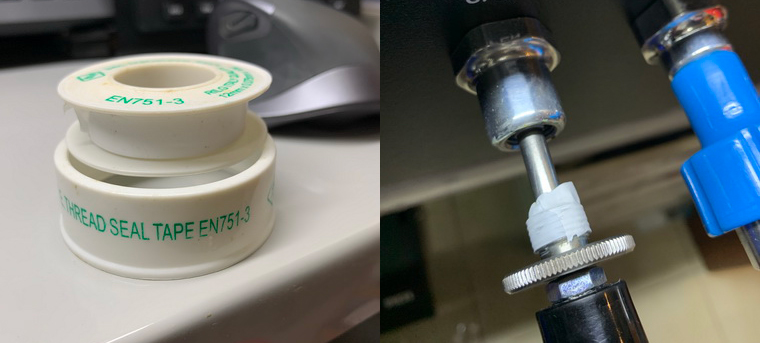
- The throttle friction lock was a bit loose. It moved when I rotated the knob.
My fix was to apply a few wounds of thread seal tape to tighten the gear gap on the friction lock. The result is positive. The fix works pretty well on it.
–
RECOMMENDATIONs
I have no reservation to give 4.5 Stars on a scale of 5 to the Redbird Alloy TH1. And I highly recommend it to anyone who needs a decently good vernier-style throttle quadrant for his flight simulation system, if space required is not a concern.
Frankly speaking, after using the Alloy TH1 extensively in the last few weeks, I tend to like it more than the VirtualFly V3RNIO+
I couldn’t exactly tell why my liking to it in words. Perhaps it’s its imperfections that resemble the reality, I guess.–
 FS Times