
–
SettingS in MSFS
Since Redbird isn’t an affliated partner with Asobo, users have to configure the Alloy RD1 in MSFS by themselves. The assignment process can’t be said complicated. But it was not straightforward either.
Also, the MSFS setting information 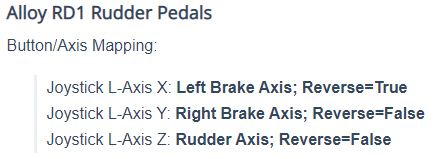 provided by the company is NOT fully CORRECT. For example, in the mapping suggestion, Redbird states that the Right Brake Axis doesn’t need to be Reversed.
But it is incorrect as I have to enable the REVERSE to use the Right Brake properly.
The company’s instruction had caused confusion in the beginning and it took me a while to figure this out myself. I reported the error to the Sales person who handled my order, and he replied immediately to me that he had copied my note to the support team. However, the error remains unchanged on the website today.
Truly poor product support responsiveness, but I have to say that the sales staff I contacted was very helpful.
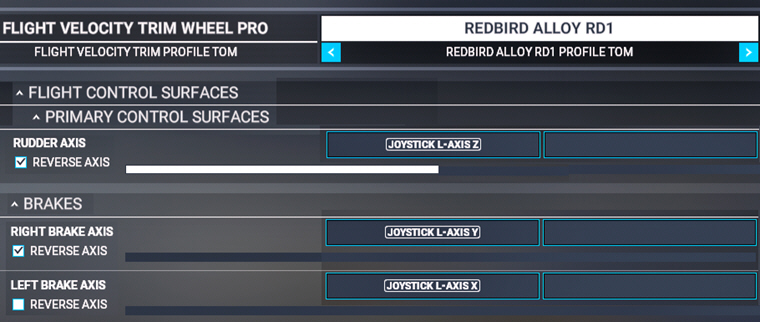
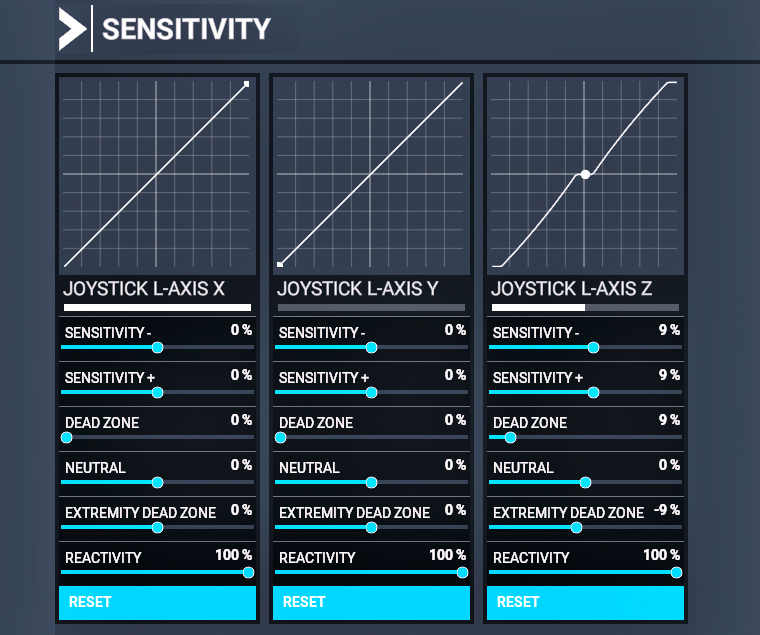
Anyway, here’s my Axes and Sensitivity settings for the Alloy RD1 in MSFS.
–
PERFORMANCE
Redbird claims that the Alloy RD1 is designed to mimic exactly what users would expect in real flying. It is also used in the company’s more sophisticated flight training systems — The Jay, TD and TD2.
The rudder pedals has a full range of travel and aircraft-style, differential toe brakes. Via an advanced spring system in the product, users can apply pressure to the rudders versus only forcing rudder travel, just like what the real aircraft does.
Although the tension of the spring is not adjustable, the travel of the pedals is smooth. With no detent, it will come back to the center of the axis automatically whether you push it hard or soft.
The toe brakes also perform fluently and quite accurate when braking the aircraft. Of course that is achieved after proper tuning in the simulator.
In general, the Alloy RD1 is very responsive. But it varies a little from aircraft to aircraft. It is also true to other rudders I’ve used before.
I couldn’t find any information whether the Alloy RD1 is using such as Hall Effect sensors and pressure sensors to convey the pedal and braking movements as found on the VirtualFly Ruddo or not.
All in all, the repeatability, or more precisely the reliability, of the pedals and differential brakes on the Alloy RD1 meets my expectation from a high-end rudder pedals.
Surprisingly, the Alloy RD1 does recall a long-forgotten feeling very close to what I felt when I flied on a real Cessna 172 many many years ago, which I didn’t expect in the first place.
–
RECOMMENDATIONs
Similar to the score I gave to Redbird Alloy TH1 in its review, I have no reservation to give 4.5 Stars on a scale of 5 to its sibling Alloy RD1.
And I highly recommend it to anyone who looks for a decently good rudder pedals to add realism to his/her flight simulation system for a long lasting performance, if cockpit floor space and budget are of no concern to them.
I have thought about replacing the Thrustmaster TPR in my other setup with another Alloy RD1. Sadly the price has gone up. The over $100 shipping cost is also a concern.
No doubt, with a price nearly $600, the overall quality of the Redbird Alloy RD1 should have been better in my opinion.
The pedals, for instance, are a bit old-fashioned, which die-cut straight from thick metal sheets, instead of machine-molded as found on the Thrustmaster TPR or VirtualFly Ruddo. That is of course my own preference.
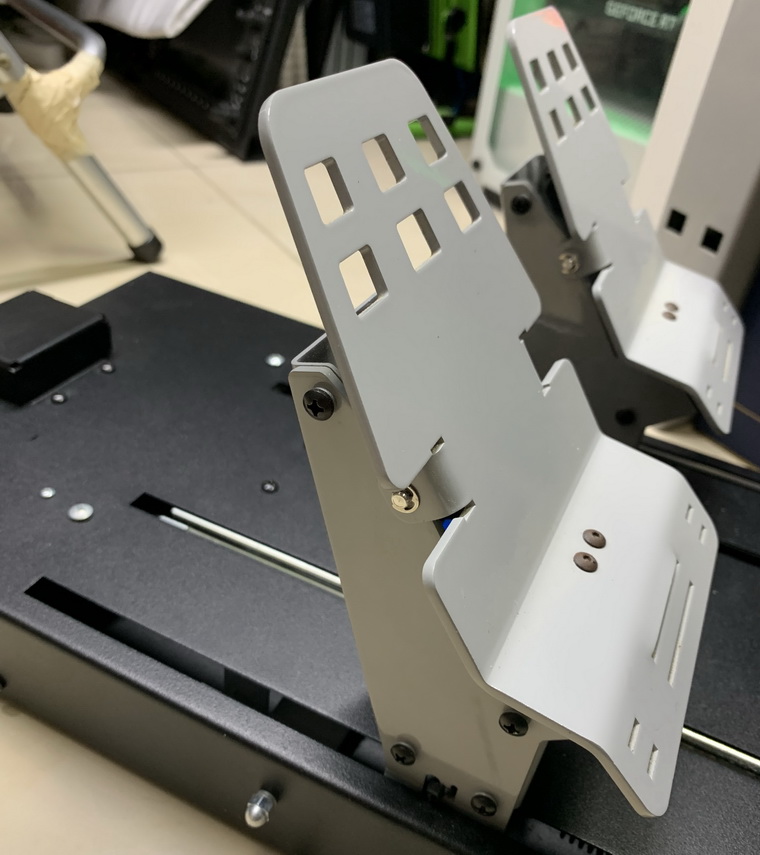 However, all four screws on the two pedals
 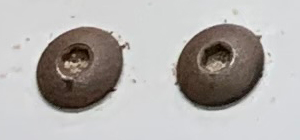 have become rusty after being used for just a few months. That is unacceptable, even though the Alloy RD1 may still lasts for decades.
I believe the spending on some good quality stainless steel or aluminium screws for the pedals should be mimimal, shouldn’t it?
Nevertheless, despite all its shortcomings, like I mentioned in the beginning of this review, the Redbird Alloy RD1 works remarkably well and out-performs all the other rudder pedals I have ever used in my current and previous setups.
That’s most important and outweighs all its imperfection to me.
As always, your mileage may vary and you don’t have to agree with me.
–
=====
*Rudder Pedals I have used so far
Logitech Pro Flight Rudder Pedals
Logitech Pro Flight Cessna Rudder Pedals
MFG Crosswind
Virtual Fly Ruddo
Thrustmaster Pendular Rudder TPR
Redbird Alloy RD1
–
 FS Times