
38: My Ultimate Cockpit Views

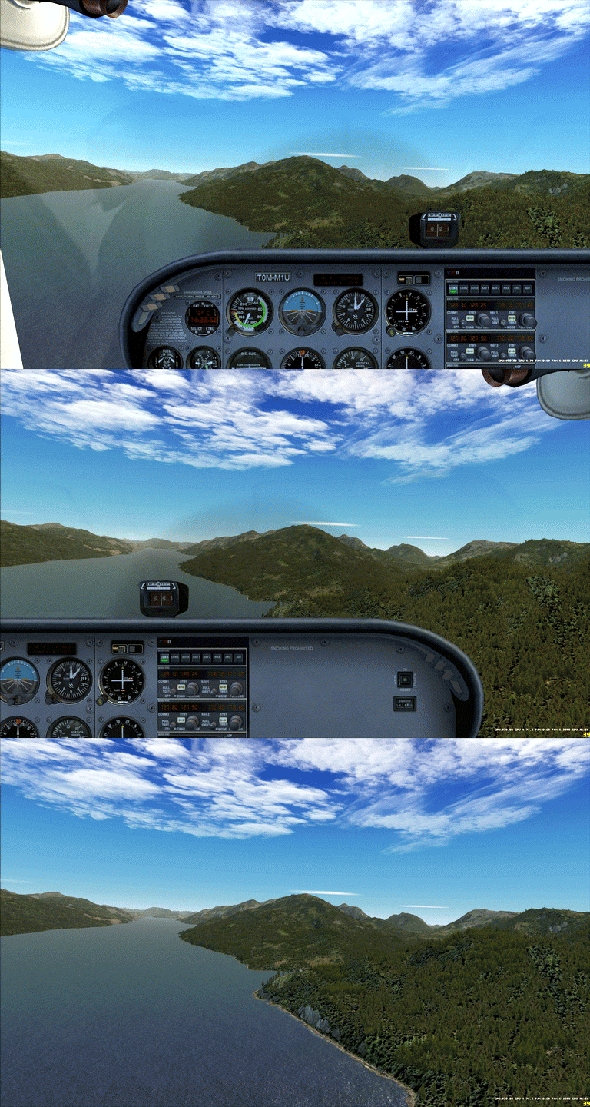
Aircrafts in FSX comes with many views (or cameras) and they are set with different zoom levels.  They are quite troublesome since I only want three of them to view from cockpit:

  1. View from the pilot seat on the left
  2. View from the passenger seat on the right
  3. View from the cockipt without panels

Moreover, I need these views to start with the same zoom level and/or eye position, so that the scenery in front stays unchanged when views are cycled through.

Always start with the same zoom level and keep scenery background remain in position

Above is the cockpit view effect I achieved on the Cessna 172 through the tweaks of Continue reading

37: Clean Install Display Driver

Display driver plays an important part in Flight Simulator.   How to install it or uninstall it will impact FSX’s performance and stability, especially when switching from NVIDIA to ATI or ATI to NVIDIA.

It is widely known that even after a program or a driver is uninstalled, many “tails” of it will still remain in the system.  It is therefore necessary to ensure that a display driver will only be installed or updated onto a clean environment at all time.

Following is how I update the ATI display driver from 11.3 to 11.4   Continue reading

36: Add New Views

The earlier post Remove Unwanted Views talks about getting rid of some views (cameras) that one doesn’t need.  This one talks about adding new views (cameras).

My system has a few Pro Flight Instrument Panels (FIPs); therefore, I want a full scenery monitor display without showing the 2D or 3D cockpit.

Although this can simply be achieved by pressing W to turn off associated panels in 2D cockpit view, the cockpit will appear again when eyepoints are panning to the right or to the left.

To address the issue, a number of options can be considered.

Continue reading

35: fsx.CFG – AverageFrameRate

fsx.CFG provides 3 sets of information about normal and slew flight.  The information will be displayed and cycled when SHIFT-Z is pressed.

To simplify and maximize the display, adjustments as shown below can be used to group the 3 sets of information into a single one for each type.
Continue reading

34: Smoke Gets in Your Plane

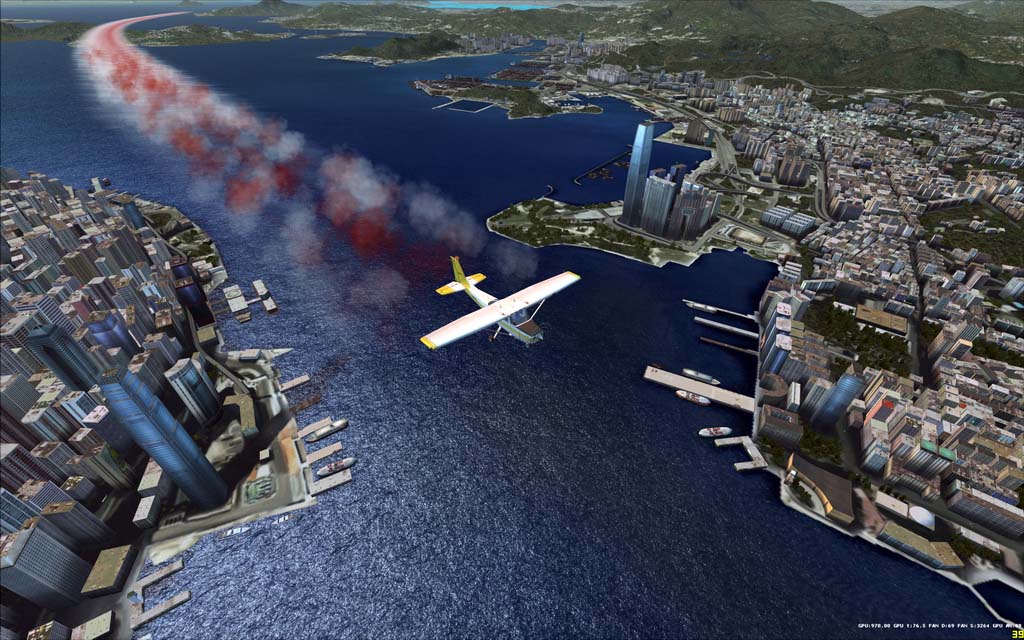
In FSX, only the Extra300, FA-18 and P51 aircrafts are pre-installed with an exhaust smoke system which can be activated by pressing the “I” key on the keyboard.

Customized Red and White Smoke System

To add the smoke effect to other aircrafts, insert the following lines at the end of the aircraft.cfg of your choice under SimObjects folder:

Continue reading

33: Fly to the Twilight Zone

Skyclock is a little app (offering both paid and free) for iphone which uses the phone’s GPS or network location service to calculate twilight periods for the present day virtually anywhere in the world.   It surely add some fun to the flightsim experience by matching the Civil, Nautical or Astronomical Twilight hours it displays.

Check it out from Skyclock or the App Store.

32: HK International Airport Bug Fix

The HK International Airport VHHH from Imagine Simulation is not a bad supplement to FlyTampa’s HK Kai Tak Airport VHHX.

However, the product is a bit overdone because it mistakenly replaces FSX’s default buildings from the adjacent area, which in fact is more true to the reality. Continue reading

31:My HD5870 Overclocking Profiles

Followings are the overclocking profiles of my ASUSTeK MATRIX HD5870 P/2DIS/2G

I generally flighsim under 970MHz setting but sometimes further OC to 1000MHz as follows:

Continue reading

30: Flight Instrument Panel Tweak – Part 3

I got three Saitek’s Pro Flight Instrument Panels.   They are good but expensive, too.  Moreover, the more of this FIP are attached to a system, the more impact of it affects FSX’s performance.

Using earlier Tweak 1 and Tweak 2,  my three Panels are setup as picture shown below, and each panel controls two related gauges:

AIRSPEED <—> RPM

ATTITUDE <—> DIRECTION

ALTITUDE <—> VERTICAL SPEED

Under this arrangement, I can simply press the up and down buttons to easily access the six basic gauges on small planes I usually fly.

Continue reading